Letter to Chief Wang
Demi-Gods and Semi-DevilsThe Letter to Chief Wang is a message tied to the secret behind the Yanmen Pass attack and the identity of the man called the “leading big brother.” Though the letter’s signature was removed, Xiao Feng remembered its distinctive handwriting. When a comparison with Duan Zhengchun’s calligraphic scroll exposed a mismatch, the document ceased to be merely a clue pointing toward revenge and became evidence that his assumed answer might be wrong.
A message with a concealed author
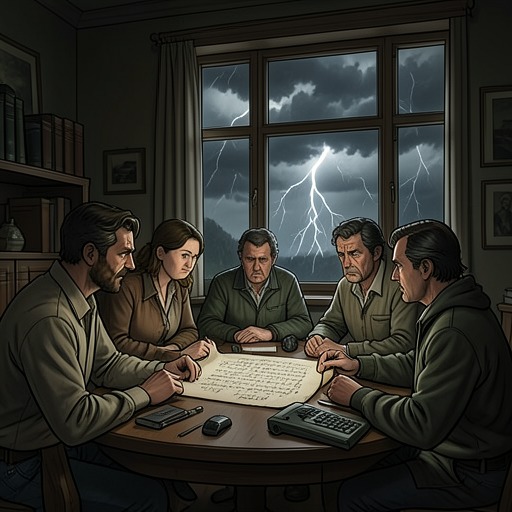
The letter entered Xiao Feng’s investigation through the events in the Apricot Forest outside Wuxi. He had seen it there, but Venerable Zhiguang tore off its signature and swallowed it, deliberately preventing him from learning the writer’s name. The act left the message’s appearance in Xiao Feng’s memory while severing its most direct proof of authorship. Its importance thus rested on partial evidence: the surviving writing could be recalled, but the name that would identify its author could not be recovered from the letter itself.
That missing signature mattered because the letter was connected to the “leading big brother,” a figure whose identity was being kept from Xiao Feng so he could not seek vengeance for his parents. Madam Ma later began to disclose the name to A'Zhu, saying that she need not conceal it from Elder Bai because he was on their side. She lowered her voice at the moment of disclosure, however, and the name did not reach Xiao Feng. The exchange made clear that the letter’s authorship was bound to a guarded secret, not simply to a matter of handwriting or correspondence.
The handwriting becomes evidence
At Little Mirror Lake, Xiao Feng’s attention returned to the letter while he was preparing to bury A'Zhu and then take his own life. A calligraphic scroll hanging in the room, attributed to “Duan the Second of Dali,” suddenly brought back the letter he had seen in the Apricot Forest. The contrast was striking to him: the scroll’s writing was rounded, smooth, elegant, and carefully spaced, whereas the letter’s characters had seemed angular and slanted, like the writing of a martial man of the jianghu. Although Xiao Feng knew little about calligraphy, he believed the difference was plain enough to be recognized at a glance.
Venerable Zhiguang’s removal of the signature had not erased the letter from Xiao Feng’s memory. He had retained a clear impression of its handwriting, and that remembered form now supplied a test independent of Madam Ma’s spoken accusation. The scroll and the letter, he concluded, were not written by the same person. If the scroll really was Duan Zhengchun’s, then its style did not match that of the letter attributed to the “leading big brother.”
The attribution breaks down
The comparison overturned the certainty that had driven Xiao Feng’s pursuit. After Madam Ma identified Duan Zhengchun as the “leading big brother,” Xiao Feng had set aside his suspicions and concentrated on revenge. Now he reasoned that Duan, capable of writing the elegant poem on the scroll, would have had no evident reason to ask someone else to write an important letter to Chief Wang—or an amorous poem to his own lover. The handwriting difference therefore seemed more than a superficial variation: it challenged the link on which Xiao Feng had based his conclusion.
Yet the contradiction did not give him a new author. Xiao Feng still found it difficult to explain why Madam Ma would lie: he believed she and Duan Zhengchun had no acquaintance, lived far apart, and had no apparent enmity that would account for a deliberate false accusation. He also wondered whether the scroll itself had been misattributed. Each possibility opened another uncertainty, leaving him unable to reconcile the anonymous letter, the scroll, and Madam Ma’s claim. The letter’s evidentiary force was consequently double-edged: it weakened one identification without resolving the secret it had been meant to expose.
From revenge toward renewed inquiry
The discovery came at the edge of an irreversible decision. Xiao Feng had written a simple four-character inscription for A'Zhu’s grave tablet and was carrying her body to bury her before killing himself. The scroll’s handwriting recalled the letter at precisely that moment. He reconsidered whether A'Zhu had died unjustly and whether the person he had blamed for his parents’ deaths was truly the same “leading big brother” named by Madam Ma. The letter thus altered the meaning of his revenge: if the attribution was false, then he had mistaken his target and A'Zhu’s death could not be separated from that mistake.
The surviving evidence stops short of identifying the writer or fully establishing why Madam Ma named Duan Zhengchun. What it does establish is the letter’s role as a material trace whose signature has been deliberately suppressed but whose handwriting remains legible in memory. In a chain of accusation, concealment, and mistaken certainty, that remembered difference interrupts vengeance and forces Xiao Feng back into investigation.